Residency Spotlight: Kartini Thomas
“I just had no idea how amazing this would be,” says Kartini Thomas, one of the Session 4 Artists in Residence. “[Glass] is changing a lot in the way that I think about sculpture.”
Kartini is one of the three Artists in Residence this summer that are also Visiting Artists at Museum of Glass (MOG) in Tacoma, Washington. She joined us on campus for Session 4, June 22 – July 3, and then spent the following week at MOG.

Since our founding, Pilchuck’s Artist in Residence program has been an integral part of our programming. The residency welcomes artists of other mediums to Pilchuck to experience the vast array of possibilities within glass. Every session Pilchuck hosts Gaffers who work closely with the Artists in Residence (AiRs) and their Artist Assistants (AAs) to help bring their visions to life in glass. For many years, this residency has brought hundreds of artists from all over the world to experience the magic of glass and Pilchuck.
In 2009, we began a partnership with the Museum of Glass and their Visiting Artist program to coordinate several artists each season to attend both of our residencies within the same summer. This collaboration creates the unique and extended opportunity for artists of other mediums to explore the material with support from some of the best glass makers and artists in the country and across several state-of-the-art facilities in our region.
Kartini is an American sculptor who currently lives and works on Oléron Island in France. Typically working in ceramics, porcelain and stoneware, Kartini creates playful and unsettling creatures inspired by microbiology, Japanese Kaiju, and modular toys.
Her residency at Pilchuck is the first time she has worked directly with glass, and she describes the experience as “mind-blowing.”

“When I look at ceramic work now, I find it frustratingly opaque. I definitely want to keep working with glass.” She says, “In the hot shop it's very immediate. Everything's in real time, so you have to know which shapes you're making before you do it, whereas in ceramics I kind of play around, I just make shapes and see how it goes, and then I can always change them.”
One of the ways Kartini found it effective to collaborate with the Gaffers, Morgan Peterson and Manolo Aguilera, was to build small plasticine models: “having to externalize what's in my head to communicate with other people has made it so much clearer for me about what I want and how I could compose a sculpture.” She says the residency has inspired not only an interest in a new medium, but new ways of thinking about her process and working collaboratively.
In addition to working with the Gaffers in the hot shop, Kartini and her Artist Assistant, Heather Sutherland, have been all over campus, bending neon in the Flat Shop, cutting flat glass in the Cold Shop, using the waterjet cutter in the BotLab, fusing glass in the Studio Building, and doing lost-wax casting in the mold room. She says she has enjoyed experimenting with layering color and backlighting glass with neon. “Heather is really versed in many different techniques, so we just decided to try almost everything,” she says. “The casting was really interesting, because in ceramics I have an additive process, like adding shapes on to a basic structure, whereas with the wax I was taking matter away, so it's really neat for me to try that.”

Kartini says she was intentional about her time, specifically focusing on getting comfortable cutting and fusing glass, a transferable skill she plans to bring back home to her home studio.
When thinking about her Museum of Glass residency following Pilchuck, she says she is going into it with lots of drawings and miniature models. “I want to use all the characteristics of glass that don't exist in ceramics —its transparency, the action of it, the superposing of colors and patterns.”
Her Museum of Glass Visiting Artist Residency allowed her the space to do just that. Inspired by Boyd Sugiki and Lisa Zerkowitz’s use of cane in their workshops at Pilchuck, Kartini arrived full of infectious excitement to introduce a new dimension to her work through glass. She is especially drawn to the hypnotic dizzying effect of glass canework, especially the superposition of alternating cane patterns and colors.
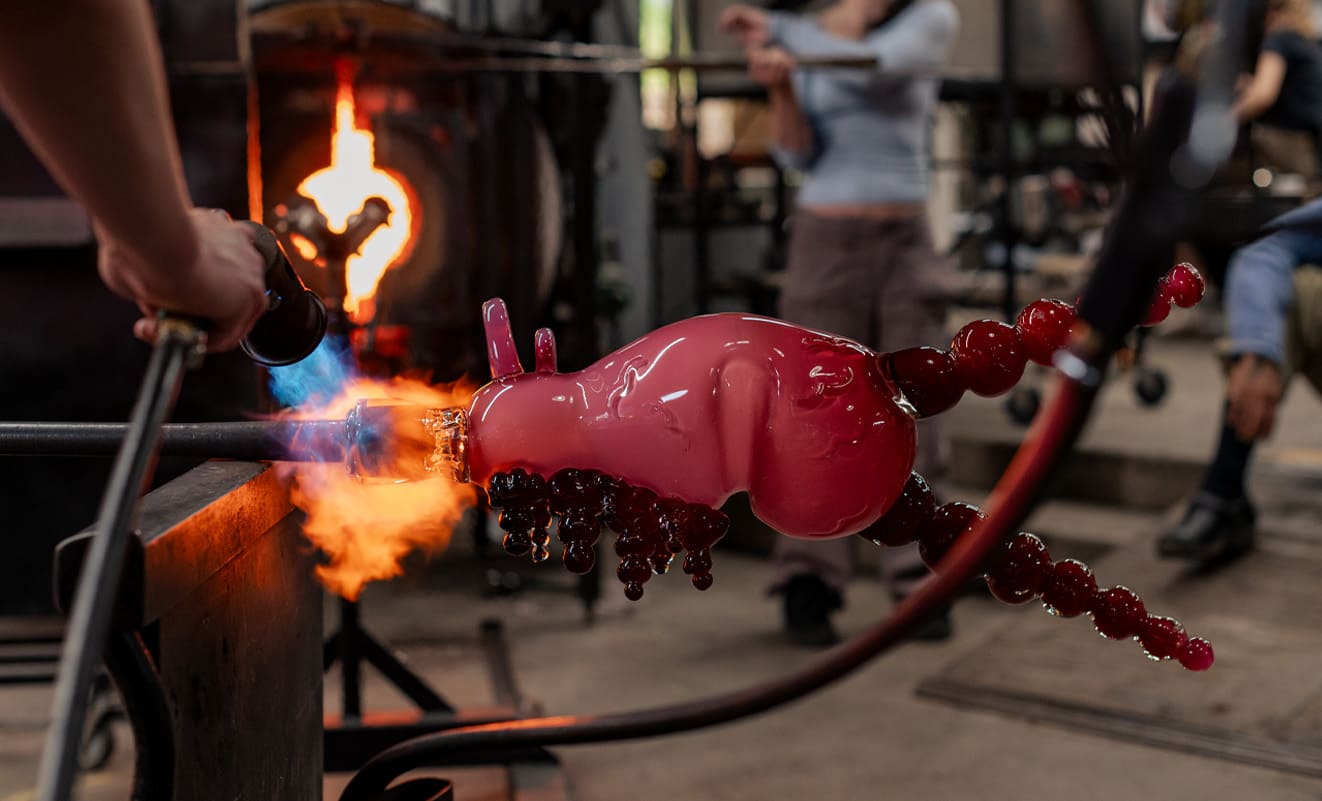
She made the most of her time with the Museum Hot Shop Team, creating several technically demanding pieces with her newfound fascination with canework and the saturated colors glass can provide. Together, they brought to life a tentacled monster with cane patterns, a pair of dueling pears with pronounced butts, and several other monsters with playful clown faces that capture Kartini’s whimsical artistic voice.
.png)
“What I didn't know is that there are so many different kinds of glass.... But the most wonderful surprise is just the kind of dance in the hot shop of people who are communicating almost telepathically, and how everyone knows where they should be. It's really beautiful to watch, and I just had no idea that there was this magical thing before coming [to Pilchuck].”
A sense of collaboration and support, she says, echoed through every step of the process, from her work with the Gaffers, getting help on projects from staff like the Woods and Metals Coordinator Alex Winston, to her relationship with her Assistant, Heather. “[Heather] has this universe of sparkle, and our styles are so compatible. She's giving me lots of amazing ideas and pushing my work further.”
When reflecting on the experience, she says “I think this is going to be a big, big influence.”
Learn more about Kartini’s residency at Museum of Glass by watching her “Meet the Artist” video on their YouTube channel.
Written in collaboration with Museum of Glass.
